(Part 3 in the series: after Scanning the Environment, and Assessing the Reality)
When I wrote the first article in this series, my reflections were anchored in the world outside the organisation – a world that is not merely changing but transforming at a pace that leaves even the most agile among us disoriented. I wrote about scanning the environment and about the five influencing forces that People Professionals must remain deeply attuned to if we are to stay viable, valuable, and relevant in the years ahead. Those reflections emerged from a growing realisation that the familiar signposts of work, careers, and capability are being steadily dismantled, even as new ones are still taking shape.
In the second article, the lens shifted inward. From the world to the workplace. From trends to truth. I wrote about assessing organisational reality by deliberately moving through the disciplines of Sifting the Past, Observing the Present, Envisioning the Future, and Creating a New Reality, and framed this work through the simple but powerful actions of Begin, Break, and Build. That article was an invitation to pause – not to romanticise what has been, nor to rush blindly toward what might be, but to honestly understand where learning functions stand today amidst accelerating change.
Yet reflection, however rigorous, cannot remain an end in itself.

At some point, reflection must convert into resolve. Insight must lead to intention. And ideas, if they are to have any meaning at all, must translate into design. This is where the third step in this journey becomes unavoidable – the need to create a blueprint for the learning function of tomorrow.
Scanning the environment and assessing reality are essential, but they are not sufficient. They help us see and understand, but they do not, on their own, prepare us to act.
What people and learning teams need next is not another learning strategy in the traditional sense of the term, nor a refreshed catalogue of programs, nor a more sophisticated calendar of interventions. What they need is a blueprint – something fundamentally different in its ambition and intent. A blueprint is an architecture. It forces us to ask uncomfortable but necessary questions: what are we actually building, why are we building it, what must it enable in a world that continues to shift beneath our feet, and how will it remain relevant when certainty itself has become a luxury. Perhaps the most difficult question of all is also the most critical – who will truly own learning when the future makes everyone uncomfortable.
The world of tomorrow will not reward activity for its own sake. It will not reward organisations that are busy, visible, or well-intentioned in their learning efforts. It will reward those that are deliberate.
In many organisations today, learning appears active and alive. There are initiatives and modules, platforms and pathways, certifications, webinars, town halls, toolkits, and dashboards. There is movement, and there is effort. And yet, in conversation after conversation with leaders, a deceptively simple question keeps surfacing – what has actually changed. Not attendance, not completion, not feedback scores, but real capability. Real behaviour. Real decisions. Real outcomes that show up when the pressure is on and the answers are not obvious.
The world of tomorrow will not reward busy learning. It will reward meaningful learning. And meaningful learning will only happen when the learning function shifts from being an enabling function that supports the business to becoming a strategic function that actively shapes business readiness. If the work of the future is evolving rapidly, then learning cannot remain static in either its structure or its thinking.
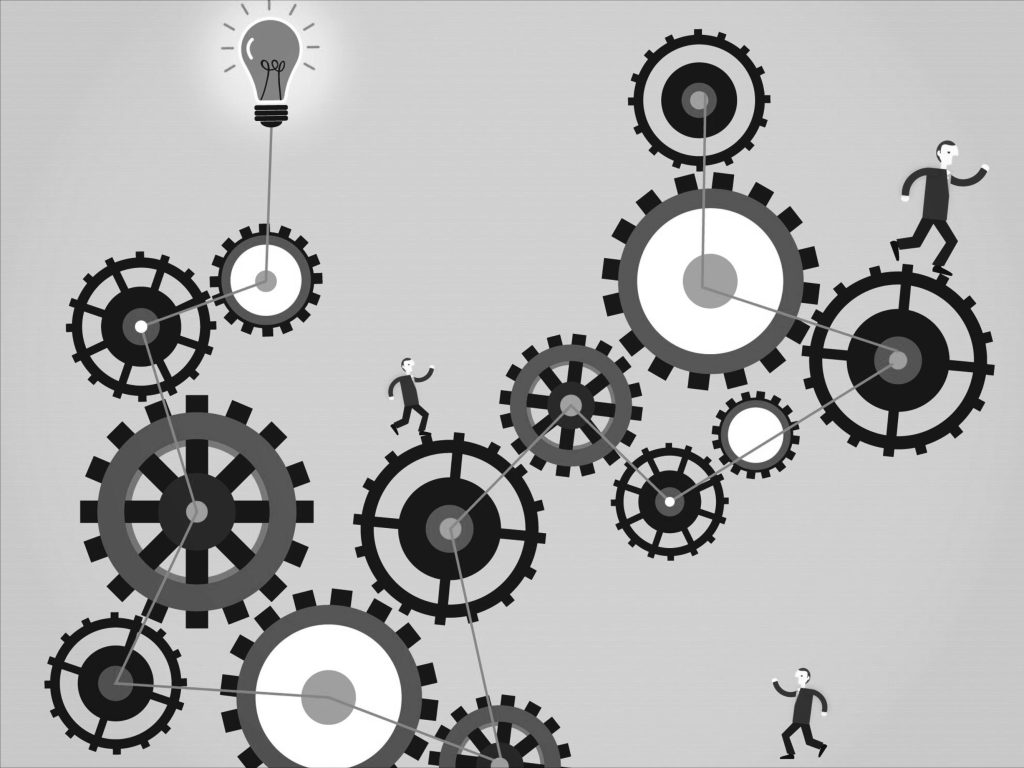
This is where the blueprint mindset becomes critical. Creating a blueprint requires us to move away from thinking of learning as a set of isolated interventions and begin to see it as a living system. Systems thinking forces coherence. It requires alignment between inputs, mechanisms, reinforcement, signals, and outputs. Business strategy, consumer shifts, technological change, and employee expectations become inputs rather than afterthoughts. Experiences, practice, feedback, coaching, communities, and nudges become the mechanisms through which capability is built. Manager ownership, governance, rhythm, and rituals provide reinforcement. Data, analytics, and behavioural outcomes act as signals. And capability shifts, decision quality, performance results, and cultural strength emerge as outputs.
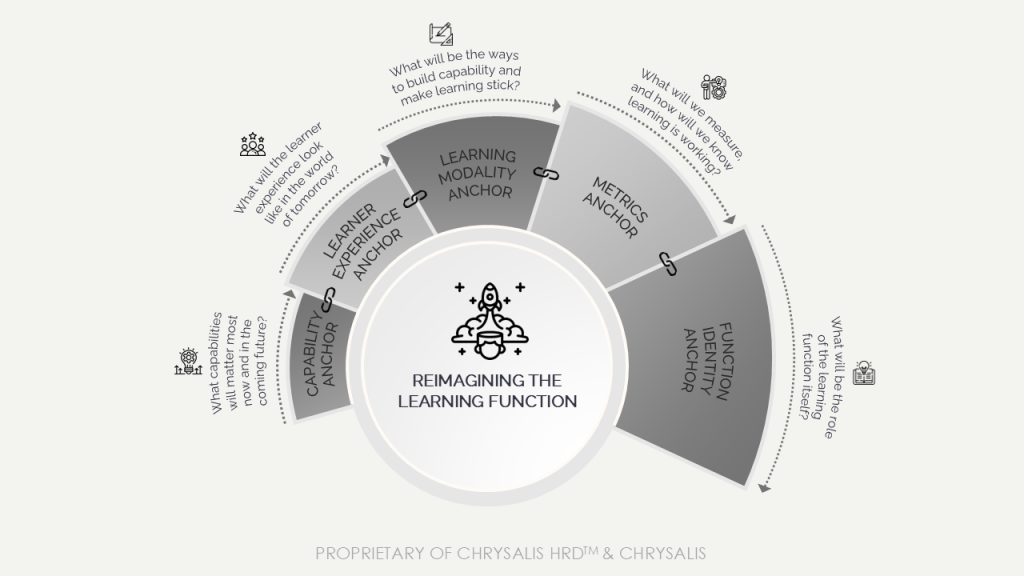
When we speak about creating a blueprint for the learning function of tomorrow, we are therefore speaking about design at a systems level, not about incremental improvement. This is why the work ahead must be anchored in a small number of deeply considered design questions.
The first of these questions is perhaps the most difficult – what capability will matter most when the future truly hits. Most organisations, when faced with uncertainty, attempt to build capability by adding more. More content, more frameworks, more models, more programs. Yet the future will demand the opposite discipline – the discipline of strategic subtraction. The organisations that thrive will be those that have the courage to identify the few capabilities that matter disproportionately and to build relentlessly around them.
Some of these capabilities will inevitably be technical and role-specific, shaped by industry and context. But the enduring ones – the capabilities that travel across roles and levels – will be profoundly human. The ability to think in systems rather than silos, to make decisions in ambiguity rather than waiting for clarity, to lead through paradox by balancing speed with safety and autonomy with accountability, to learn and unlearn without ego, and to remain humane in a world that is growing increasingly automated. A blueprint begins by placing a clear stake in the ground about what the organisation will be known for, and then building everything else around that commitment.
The second design question follows naturally – what will the learner experience look like in the world of tomorrow. In that future, learning will no longer be an event to attend or a requirement to fulfil. It will be an experience that is woven into work, identity, aspiration, and belonging. In my earlier reflections, I asked whether learning could move away from mandate to invitation. That is no longer a theoretical question. It is a practical reality.
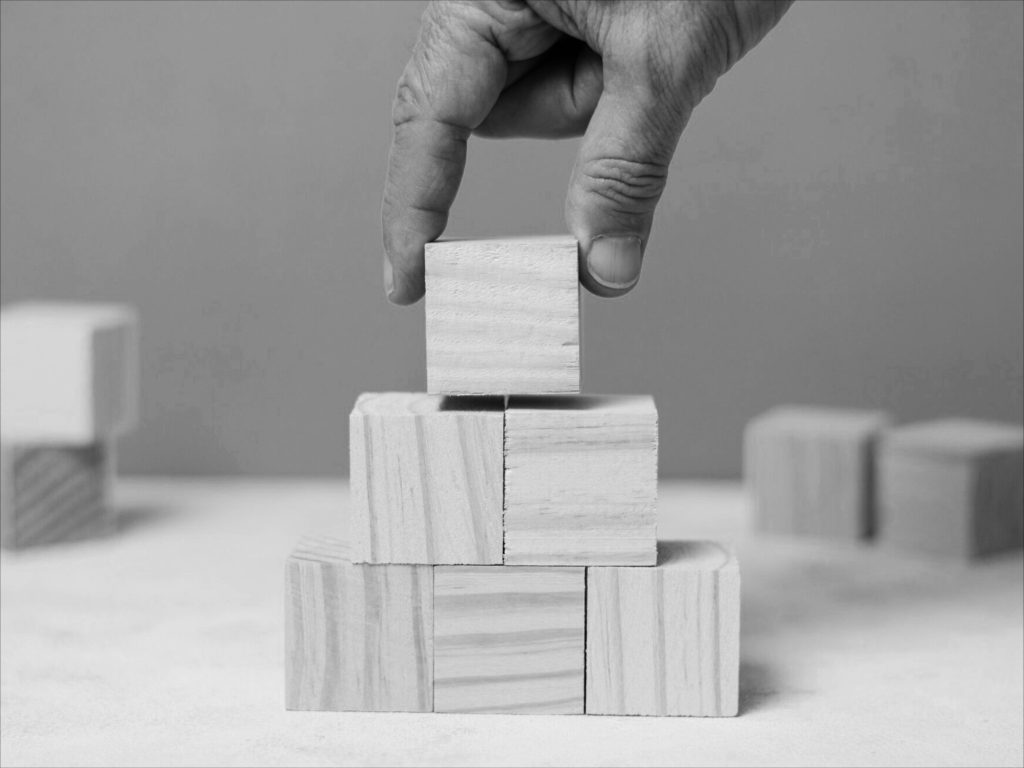
The workforce of tomorrow will not respond to compulsory learning in the way previous generations may have. People will choose learning when it is relevant, personalised, respectful of their time, connected to their goals, aligned to real work problems, and when it creates visible advantage. This requires a decisive shift away from one-size-fits-all design towards learning experiences built on choice, context, flow, and practice. Learning anchored in real work, embedded in the rhythm of organisational life, and designed as rehearsal rather than exposure changes the fundamental relationship people have with learning. The question ceases to be how we train people and becomes how we create learning ecosystems that people genuinely want to enter.
This shift also demands that we ask ourselves the next question – what is the new underlying learning equation. For a long time, the dominant assumption has been that content delivered in classrooms or digital formats leads to capability.
In the world of tomorrow, that equation no longer holds. Capability will be built through experience, practice, feedback, and reflection, intentionally designed and thoughtfully sequenced. Learning journeys may begin with a provocation to shift thinking, move into simulations or practice labs to build judgment, extend into workplace experiments that require immediate application, and be supported by peer learning circles and manager coaching that anchor accountability. When learning is designed this way, capability becomes visible, learning becomes sticky, and organisations begin to develop muscle rather than memory.
Measurement, too, must evolve if the blueprint is to be credible. In the second article, I posed questions about whether learning effectiveness would be measured on the job, through micro-KRAs, behavioural outcomes, or analytics. These questions are no longer optional. A blueprint must contain a clear measurement philosophy. This brings us to the next question – what will we measure and how will we know that learning is working. If learning is measured only through satisfaction, organisations will continue to optimise for entertainment. If it is measured through behaviour, they will begin to optimise for capability. And if it is measured through business outcomes, learning will finally earn its seat at the strategy table.
In the world of tomorrow, learning teams will need to track not just what people completed but what they changed, not just what they know but how they decide, and not just effort but impact. This requires the capability to measure application, habit formation, decision quality, leadership behaviour, manager reinforcement, and business outcomes linked directly to capability. It also requires courage – the courage to stop doing learning that does not move the needle, no matter how popular or well-received it may be.
All of this inevitably leads to the fifth and perhaps most important question – what will be the role of the learning function itself. In the future, learning teams cannot remain support teams operating on the margins of the business. They must become architects. Architects do not build everything themselves, but they design the structure, rhythm, governance, and culture that enable others to build well. The learning function of tomorrow will need to curate ecosystems rather than create everything in-house, borrow widely from disciplines and domains beyond its own, build internal capability for facilitation, coaching, and systems design, and integrate technology intelligently without becoming tech-led at the cost of humanity. Most importantly, it must help create a culture where learning is not a department but a way of operating.
When people, process, experiences, measurement, technology, and culture are aligned and allowed to evolve together, learning ceases to be episodic. It becomes systemic.
If this blueprint were to be distilled into a small set of anchors, four stand out. The first is a clear capability architecture that is focused enough to guide decisions yet robust enough to endure change. The second is a learning experience ecosystem designed as journeys, labs, communities, and practice rather than programs alone. The third is a reinforcement system that positions managers as multipliers and the business as co-owner, embedding learning into organisational rhythms and rituals. The fourth is a measurement and insight engine that tracks behaviour and outcomes, ensuring that learning remains a strategic lever rather than a cost centre.
Yet beyond architecture and systems lies something even more fundamental. As science and technology intensify, work paradoxically becomes both easier and more complex. And within that complexity, there is a real risk that human connection becomes superficial. This is where the learning function has a profound opportunity – and responsibility. Beyond building capability, the learning function of tomorrow can become a steward of humanity within organisations. Not through moral sermons or abstract ideals, but through deeply practical design that helps people think better, choose wiser, connect more authentically, and lead with greater compassion.

The organisations that succeed in the future will not only be those that adopt technology faster. They will be those that develop people better – people who can navigate complexity with wisdom, hold paradox without paralysis, and remain deeply human even as machines grow more intelligent. In this future, the learning function will evolve from making people good at their jobs to helping people become better human beings at work.
And if we do this well, learning will no longer be an enabling function at all. It will become what organisations of tomorrow cannot survive without – a strategic capability, a humane force, and an architecture for resilience.