When Conversations About Careers Begin to Sound Different
A few weeks ago, I found myself moving through a series of conversations that, at first glance, appeared completely unrelated. In one meeting, a senior banking professional in his fifties spoke quietly about how artificial intelligence was beginning to automate parts of the work he had spent nearly three decades mastering. There was no panic in his voice, only a kind of restrained disorientation, as though the foundations beneath his professional identity had shifted slightly without warning. “For the first time in my career,” he admitted, “I’m wondering whether experience itself is enough anymore.”
Later that evening, I found myself speaking to a millennial leader who, by every conventional definition, had succeeded. Strong compensation, senior role, global exposure, visibility within her organisation. Yet somewhere in the middle of our conversation, she paused and asked a question that carried far more exhaustion than ambition. She wondered aloud whether she even wanted to continue accelerating at the pace she had spent fifteen years training herself to sustain.
A few days later, I met a twenty-four-year-old product designer who was simultaneously freelancing, experimenting with AI tools, collaborating with a startup, building content online, and considering a master’s degree she was not even certain she wanted. When I asked her what kind of career she hoped to build, she smiled and said something that would have sounded deeply strange a generation ago. “I don’t really want one career,” she said. “I want multiple versions of myself.”
What struck me was not the difference between these individuals, but the common thread running beneath all three conversations. For perhaps the first time in modern professional history, multiple generations are simultaneously uncertain about what careers are supposed to look like, how they are supposed to unfold, and perhaps most importantly, what they are ultimately supposed to mean.
The Career Ladder That Once Defined Success

For decades, careers followed relatively understandable structures. One studied, specialised, joined an organisation, worked hard, climbed steadily, and hoped that loyalty, competence, and endurance would eventually convert into stability, growth, and identity. The journey was rarely easy, but it was at least visible. Careers moved like ladders. Progression could be mapped. The next step was usually recognisable because industries themselves changed slowly enough for people to build expertise gradually over time.
The psychological contract was simple. Work hard, remain valuable, stay loyal, and the future will become safer as your experience deepens. That contract is now beginning to fracture.
What makes this moment in the world of work so profound is not merely that jobs are changing. Jobs have always changed. Entire industries have disappeared before. Technology has disrupted work repeatedly throughout history. But what feels fundamentally different now is the speed, simultaneity, and psychological intensity of the disruption. Artificial intelligence is not simply changing tasks. It is changing the shelf life of expertise itself. Entire categories of work are being redesigned while people are still building careers inside them. Roles are evolving faster than organisations themselves can fully comprehend. Layoffs dominate headlines even within companies that appear profitable and stable. Professionals who once believed experience itself guaranteed security are suddenly confronting a deeply unfamiliar possibility: what if the very thing they spent years mastering no longer retains the same value it once did?
And once expertise becomes unstable, careers stop feeling predictable.
AI Is Not Just Disrupting Jobs. It Is Disrupting Professional Identity

Much of the conversation around AI has understandably focused on replacement. Which jobs will disappear? Which industries will automate faster? Which functions will shrink? These are important questions, but they are not the deepest questions.
The deeper disruption is psychological because AI is destabilising something far more fundamental than employment structures alone. It is destabilising the relationship between work and identity.
For generations, professional identity was built around expertise. People defined themselves through stable labels. I am a banker. I am a marketer. I am a lawyer. I am an engineer. Careers were not merely economic structures; they were emotional and social anchors through which people understood competence, status, ambition, and self-worth. Experience accumulated value because the world surrounding that experience remained relatively stable.
Today, however, a growing number of professionals are beginning to realise that experience itself may depreciate faster than before. The capabilities that made someone successful yesterday may not necessarily protect them tomorrow. This is one of the reasons careers themselves are beginning to take very different forms. Some are becoming lateral rather than vertical, moving across industries and functions instead of climbing one hierarchy continuously. Others are becoming cyclical, where people move in and out of corporate life, entrepreneurship, consulting, freelancing, caregiving, or reinvention phases across different seasons of life. Increasingly, many careers are becoming portfolio-based, where individuals build multiple professional identities simultaneously rather than attaching themselves entirely to one organisation or role.
A young professional today may work in consulting, create content online, collaborate with startups, experiment with AI tools, and pursue independent projects all at the same time. Not because they are unfocused, but because they no longer fully trust the safety of singular professional dependence. The career itself is becoming diversified, and beneath that diversification lies something deeper than ambition. It is self-protection in an environment where certainty itself has become fragile.
Why Different Generations Are Responding So Differently
What makes this transition even more fascinating is that every generation is responding to career uncertainty through the lens of a completely different psychological contract with work. The anxiety may be shared, but the meaning attached to work is not.
Gen X and the Fear of Losing Relevance

For many Gen X professionals, careers were built through endurance, consistency, and deep expertise. This was the generation that believed stability was earned gradually over time. Long tenure carried meaning. Institutional knowledge mattered. Experience created authority.
Which is why AI disruption can feel particularly destabilising for this generation.
I recently met a senior leader in a large organisation who confessed something with surprising honesty. Every night, after his family had gone to sleep, he had quietly begun teaching himself AI tools through online videos. Not because anyone had demanded it yet, but because he feared falling behind in conversations he once led comfortably. What struck me was not the learning itself. It was the secrecy. He did not want his team to know he felt uncertain.
For many experienced professionals, the fear is not simply technological obsolescence. It is identity disruption. When someone has spent decades becoming credible, respected, and capable, the idea that the rules themselves may suddenly change can feel psychologically unsettling in ways younger generations may not fully understand.
And yet, this generation also possesses something increasingly valuable in a world becoming hyper-automated: judgment. AI may process information faster, but judgment still requires context, ethics, discernment, human understanding, and systems thinking. Gen X professionals may not compete on speed alone, but they may become extraordinarily important in helping organisations interpret complexity rather than merely process it. Their challenge is not whether they still have value. It is whether they can adapt without feeling that adaptation erases everything they already know.
Millennials and the Exhaustion of Endless Acceleration
Millennials occupy perhaps the most emotionally conflicted position in the workforce today. This was the generation that optimised hardest for achievement. They were raised during the rise of globalisation, professional acceleration, and the belief that ambition would eventually create freedom. Careers became deeply tied to identity itself. Professional success became proof of personal worth.
For a while, the equation appeared to work. Titles expanded. Compensation increased. Opportunities grew. But so did exhaustion.
Many millennials became the generation that normalised hustle culture long before they began questioning it. They climbed aggressively, only to discover that endless acceleration itself could become psychologically unsustainable. And now, just as many have reached mid-career leadership, AI is beginning to disrupt precisely the kinds of cognitive and managerial work they spent years mastering.
A senior marketing leader I met recently captured this tension perfectly when she said, “I sometimes feel like I spent fifteen years learning how to succeed in a system that itself is changing.” Beneath that statement lies a deeper exhaustion that many millennials carry quietly. They are not rejecting ambition entirely, but they are increasingly questioning the emotional bargain they made with work. They want growth, but not at the cost of psychological depletion. They want relevance, but not endless burnout. They want achievement, but also meaning, sustainability, and space for identities beyond performance itself.
For millennials, future-proofing may require something profoundly difficult: learning how to reinvent themselves professionally without interpreting reinvention as failure.
Gen Z and the Rise of Fluid Careers
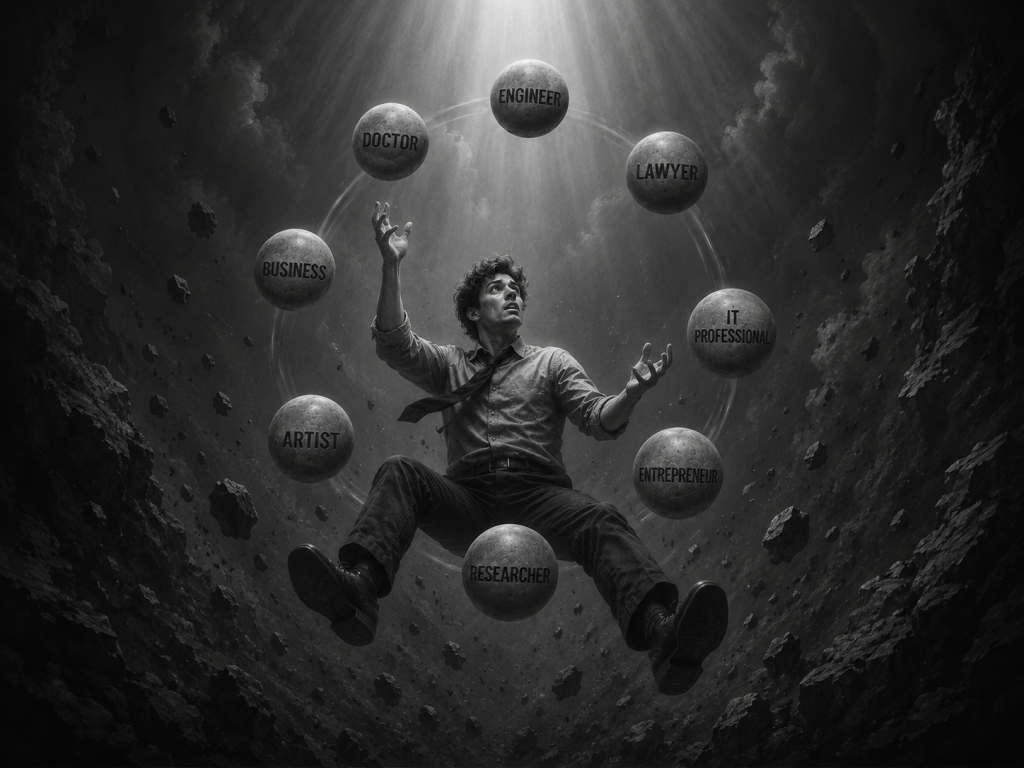
Gen Z enters the workforce with a radically different orientation toward careers altogether. Unlike earlier generations, many younger professionals never fully believed organisations would provide long-term security. They grew up amidst economic instability, startup collapses, visible layoffs, social media comparison, pandemic disruption, and now AI acceleration. Uncertainty was not an interruption to stability. It was the environment itself.
As a result, many younger professionals approach careers with fluidity rather than permanence. Titles matter less. Identity matters more. Flexibility matters more. Freedom matters more.
A young designer I met recently explained that she was intentionally building “multiple futures” simultaneously. She worked full-time, freelanced selectively, collaborated on side projects, experimented constantly with emerging technologies, and built digital visibility outside her employer ecosystem. “What if one thing disappears?” she asked casually. “I don’t think we can rely on one career anymore.”
There is enormous adaptability in that mindset, but there is also anxiety beneath it. Because while younger professionals may appear more flexible, they are also navigating unprecedented levels of uncertainty, fragmentation, comparison, and pressure to remain constantly relevant. In trying to stay adaptable, many risk becoming broad without becoming deeply skilled in anything durable.
Ironically, in a world obsessed with speed, one of the greatest long-term advantages may still belong to those capable of staying with something long enough to develop genuine mastery. Because while AI accelerates access to information, depth still requires time, reflection, discipline, and deliberate practice.
What Does It Really Mean to Future-Proof a Career?
Perhaps the biggest misunderstanding around future-proofing careers is the belief that it simply means learning more tools faster. Technical capability matters enormously. AI literacy matters. Adaptability matters. Continuous learning matters.
But increasingly, the professionals who may endure are not necessarily those who know the most. They may be those who can evolve the most coherently.
The future-proof career is unlikely to belong to individuals who attach themselves rigidly to one identity, one industry, or one version of success forever. Nor will it belong to those who endlessly chase every trend without building depth anywhere meaningful. Instead, the future may belong to people who can combine adaptability with grounding, reinvention with coherence, ambition with humanity, and learning agility with emotional resilience.
Because as AI grows more powerful, many of the capabilities that become scarce may not be technical at all. They may be profoundly human. Judgment. Systems thinking. Emotional intelligence. Discernment. Communication. Relationship-building. The ability to navigate ambiguity without paralysis. The ability to continue learning without becoming psychologically fragmented by constant reinvention.
Careers Without Maps

Perhaps this is the real shift taking place beneath all the noise around layoffs, AI, and disruption. Careers are no longer behaving like ladders. They are behaving like journeys through uncertain terrain. They move sideways, pause unexpectedly, reinvent themselves, fragment into projects, evolve through seasons, and increasingly require people to redefine success repeatedly across the course of their lives.
This can feel deeply unsettling, but perhaps it is also forcing us to ask better questions. Not merely, “What job will survive?” but rather, “What kind of human being can continue evolving meaningfully in a world where work itself keeps changing?”
At Chrysalis, we increasingly believe that the future of careers will belong less to those who pursue predictability at all costs and more to those capable of combining adaptability with self-awareness, capability with reinvention, and ambition with humanity. Because careers may no longer move in straight lines, but perhaps that is precisely what is forcing us to rethink what success was supposed to mean all along.