On 23 August 2023, India watched history unfold as Chandrayaan-3 successfully landed near the Moon’s south pole. It was a moment of immense national pride, celebrated as a triumph of science, engineering and perseverance. Around the world, commentators marvelled at how a space agency operating with comparatively modest resources had achieved what only a handful of nations had accomplished.
Most people remember the success. I have always found the more interesting story to be the one that came before it.
Four years earlier, Chandrayaan-2 had come agonisingly close to achieving the same objective before communication with the Vikram lander was lost during its final descent. For the scientists who had devoted years to the mission, it was heartbreaking. For a nation that had travelled emotionally with them, it was equally painful. Years of preparation had ended in disappointment, visible to millions.
What happened next, however, is what truly defines great organisations.

There was no public search for scapegoats. No attempt to protect reputations. No dramatic leadership reshuffle designed to reassure observers that someone had been held accountable. Instead, ISRO did something that remarkably few organisations manage to do consistently. It became intensely curious. It questioned its assumptions, examined every stage of the mission with scientific discipline, redesigned systems, strengthened processes and treated every failure not as an embarrassment but as data. Four years later, Chandrayaan-3 succeeded, but the real achievement had occurred long before the spacecraft left the launch pad. The organisation itself had become better.
That distinction has stayed with me because, over the past three decades, I have seen organisations succeed and fail for reasons that rarely appear in annual reports.
I have worked with organisations experiencing explosive growth and with others navigating painful decline. I have seen businesses with outstanding strategies struggle to execute them, while others with seemingly ordinary strategies consistently outperformed expectations. I have watched organisations invest billions in technology yet become less agile, and I have seen organisations with comparatively modest resources repeatedly outperform much larger competitors.
The answers were never found solely in strategy, leadership capability or financial strength. There always seemed to be another layer beneath the visible organisation – something that shaped how people thought, how they made decisions, how quickly they learnt, how confidently they adapted and, ultimately, how effectively the organisation responded when circumstances changed.
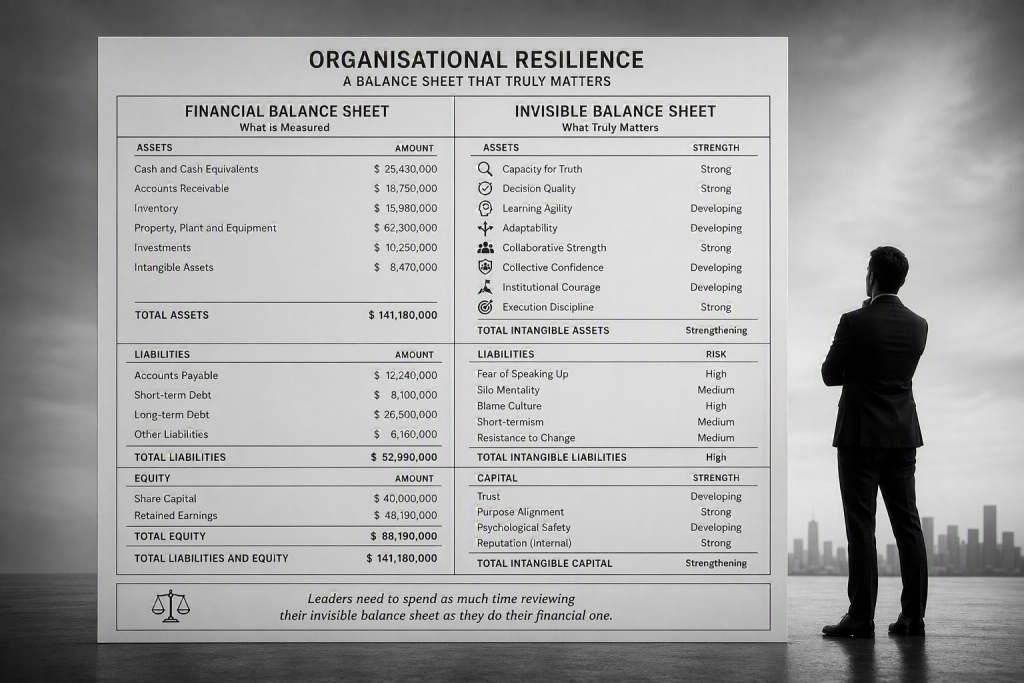
I have, over time, realised that every organisation manages two balance sheets.
The first is familiar to every board and every CEO. It records revenue, profitability, assets, liabilities, cash flow and shareholder value. It tells us how the organisation is performing today and is reviewed with extraordinary discipline because it is measurable, visible and financially significant.
The second balance sheet is almost never discussed. It does not appear in annual reports. It is not audited. It has no accounting standard. Investors rarely ask about it. Yet I have increasingly come to believe that it exerts a greater influence on an organisation’s future than the financial balance sheet itself. I call it the Invisible Balance Sheet.
Unlike financial assets, the assets on this balance sheet cannot be expressed in currency. They exist in capability. They determine whether an organisation can respond intelligently when certainty disappears, whether it can adapt when markets shift, whether it can innovate when competitors emerge and whether it can execute consistently under pressure.
I have come to believe that this invisible balance sheet is made up of eight critical organisational assets.
The first is Capacity for Truth – the speed at which reality reaches the people capable of acting on it. Most organisations do not fail because they lack information. They fail because uncomfortable information arrives too late, becomes diluted as it moves through layers of hierarchy or is quietly ignored because it challenges long-held assumptions.
Kodak did not fail because it was unaware of digital photography. In fact, one of its own engineers developed one of the earliest digital cameras. Nokia understood smartphones long before its market leadership declined. Blockbuster recognised changing customer behaviour well before streaming became mainstream. The issue was rarely knowledge. It was whether the organisation possessed the capacity to confront uncomfortable truths while meaningful choices still remained.
The second asset is Decision Quality. Every organisation prides itself on making decisions, yet remarkably few examine the conditions under which those decisions are made. High-quality decisions rarely emerge from intelligence alone. They emerge from environments where people feel able to challenge assumptions, where differing opinions are welcomed rather than suppressed and where uncertainty is acknowledged rather than disguised.
The COVID-19 pandemic illustrated this vividly. Faced with the same uncertainty, some organisations moved rapidly to protect cash flow, redesign supply chains, accelerate digital capabilities and communicate transparently with employees. Others waited for certainty that never arrived. The difference was not information. It was organisational capability.
The third asset is Learning Agility. This is not about training programmes or learning hours. It is about whether an organisation genuinely becomes wiser after experience.
ISRO demonstrated this after Chandrayaan-2. It did not simply investigate a failed mission. It strengthened the capabilities that would eventually make a successful mission possible. Toyota has built an entire operating philosophy around the same principle. Continuous improvement is not an initiative. It is a deeply embedded organisational habit. Every problem is treated as an opportunity to improve the system rather than merely solve the immediate issue.
Learning, therefore, is not measured by how much knowledge an organisation possesses. It is measured by how quickly experience changes behaviour.
The fourth asset is Adaptability. Many organisations believe adaptability begins when disruption arrives. It does not. Adaptability is built long before disruption becomes visible.
Microsoft’s transformation under Satya Nadella is a powerful example. Rather than defending historical strengths, the organisation fundamentally rethought its identity, embracing cloud computing, collaboration and open ecosystems. Netflix made an equally courageous decision when it invested aggressively in streaming despite knowing it would cannibalise its own DVD rental business. Both organisations understood that protecting yesterday’s success is often the fastest route to tomorrow’s irrelevance.
The fifth asset is Collaborative Strength. The most valuable business problems today refuse to sit neatly within organisational charts. Artificial intelligence, customer experience, sustainability, innovation and digital transformation demand collaboration across disciplines, functions and geographies. Apple’s success has never been driven by engineering excellence alone. It has depended upon extraordinary collaboration between design, hardware, software, manufacturing, supply chain management, retail and marketing. Collaboration, therefore, is no longer a cultural aspiration. It is an organisational capability that directly influences competitive advantage.
The sixth asset is Collective Confidence. This is often confused with optimism, but the two are fundamentally different. Optimism hopes things will improve. Confidence believes the organisation possesses the capability to improve them. It develops because people have repeatedly experienced difficult situations, solved meaningful problems and emerged stronger than before. Organisations with strong collective confidence are not immune to crises. They simply respond differently when those crises arrive.
The seventh asset is Institutional Courage. Every organisation eventually encounters uncomfortable realities. A product that no longer serves the market. A business model that is losing relevance. A strategic initiative that is failing despite significant investment. A high-performing executive whose behaviour is quietly eroding culture. The question is rarely whether these realities exist. The question is how quickly the organisation is prepared to confront them.
Institutional courage is not about taking reckless risks or making dramatic decisions. It is about consistently choosing truth over comfort. It is the willingness to question assumptions that have delivered success in the past, to discontinue initiatives that no longer create value and to challenge deeply held beliefs before external events force the organisation’s hand.
History repeatedly demonstrates that organisations seldom collapse because disruption arrived unexpectedly. More often, they decline because they recognised the disruption but delayed acting upon it. They hoped market conditions would improve, that competitors would falter or that incremental adjustments would be enough. In doing so, they gradually depleted one of the most valuable assets on their invisible balance sheet – the courage to act before certainty exists.
The eighth and perhaps least celebrated asset is Execution Discipline. Ideas have never been scarce. Vision statements are rarely uninspiring. Strategic plans are seldom poorly written. Yet organisations continue to disappoint themselves because execution demands something far more difficult than inspiration. It demands consistency. It requires thousands of people making thousands of aligned decisions every day, often long after the excitement surrounding a new initiative has disappeared.
Execution discipline is what transforms ambition into reality. It is the organisational capability that ensures strategy survives contact with complexity. Without it, even brilliant ideas remain trapped inside PowerPoint presentations and leadership off-sites. With it, ordinary ideas often produce extraordinary outcomes because the organisation has developed the discipline to execute consistently over time.
What makes these eight assets particularly powerful is that they do not exist independently. They reinforce one another.
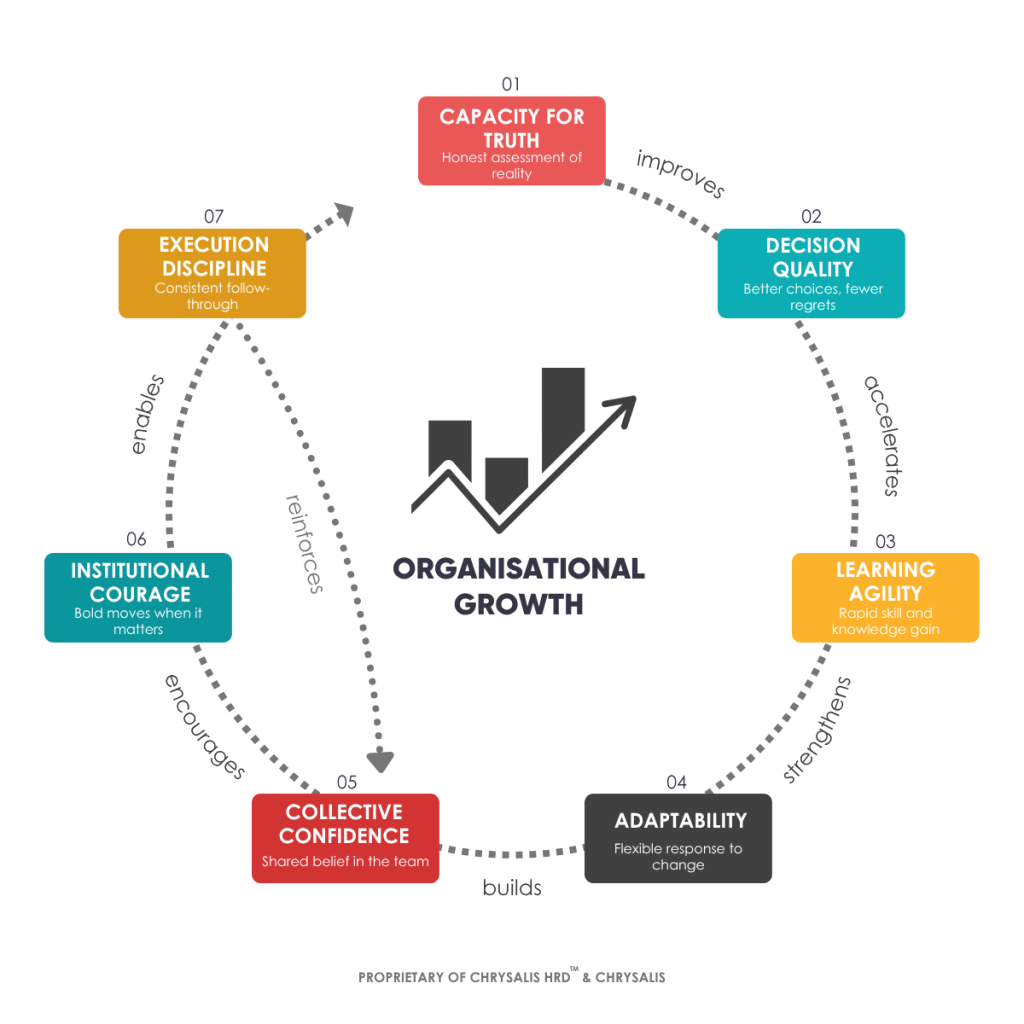
The capacity for truth improves the quality of decisions. Better decisions accelerate learning. Continuous learning strengthens adaptability. Adaptability builds confidence because people repeatedly experience successful change. Confidence encourages courage, making difficult conversations easier to have. Courage enables decisive execution. Successful execution reinforces confidence once again, creating a powerful cycle of organisational growth.
The opposite is equally true. When truth is suppressed, decisions deteriorate. Poor decisions reduce learning because organisations become more interested in protecting themselves than understanding themselves. Reduced learning weakens adaptability. As adaptability declines, confidence gives way to hesitation. Hesitation erodes courage. Without courage, execution becomes inconsistent, and performance inevitably begins to suffer.
Like compound interest, invisible assets rarely grow or decline dramatically in a single year. They accumulate quietly through thousands of interactions that appear insignificant in isolation but become transformational when viewed collectively.
This is why the strongest organisations often appear remarkably resilient during periods of disruption. Observers frequently attribute their success to visionary leadership, superior strategy or financial strength. While those factors certainly matter, they are usually the visible outcomes of something much deeper. Years before disruption arrived, these organisations had already been investing in the invisible capabilities that allowed them to respond effectively when uncertainty became reality.
Whether organisations are navigating digital transformation, responding to geopolitical uncertainty, integrating acquisitions, building future leaders or reinventing their business models, success depends less on the visible assets they report and more on the invisible capabilities they have patiently built over time.
Financial capital can be raised. Technology can be purchased. Infrastructure can be replicated. Even talent can be hired. But organisational capability cannot be acquired overnight. It is earned.
It is accumulated through years of leadership decisions, cultural choices, everyday conversations and behaviours that collectively shape how an organisation thinks, learns and responds. Perhaps that is why I believe leaders need to spend as much time reviewing their invisible balance sheet as they do their financial one.
Boards routinely examine profitability, cash flow, margins and return on investment because they understand that what gets measured gets managed. Imagine if leadership teams brought the same discipline to reviewing their organisational assets.
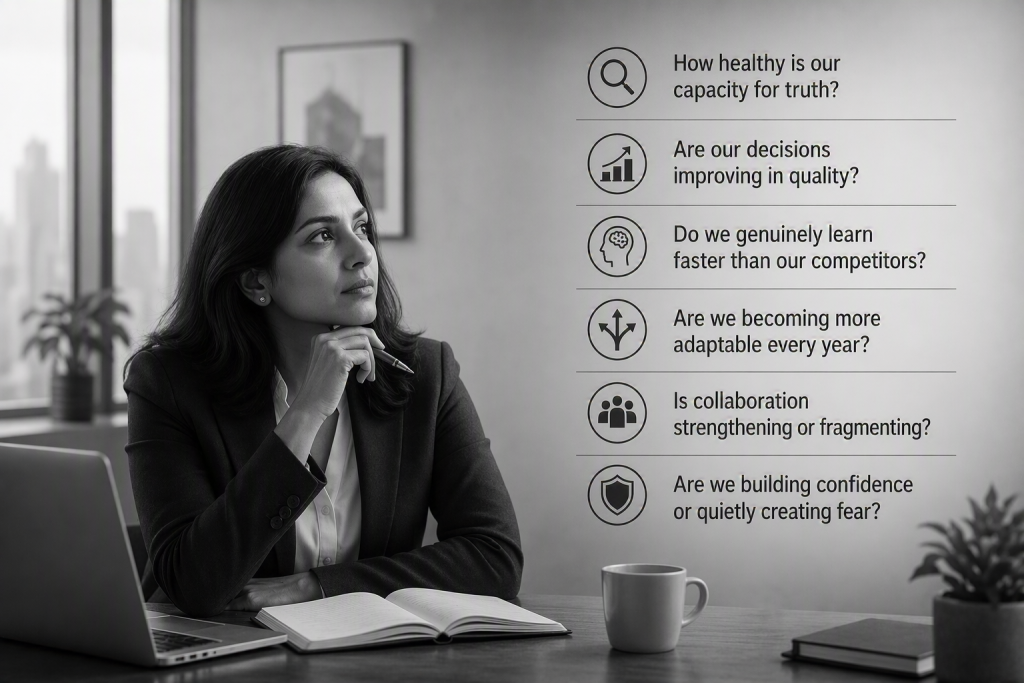
- How healthy is our capacity for truth?
- Are our decisions improving in quality?
- Do we genuinely learn faster than our competitors?
- Are we becoming more adaptable every year?
- Is collaboration strengthening or fragmenting?
- Are we building confidence or quietly creating fear?
- Do we consistently demonstrate courage when faced with uncomfortable realities?
- Can we reliably execute what we commit to?
The answers to these questions may never appear in an annual report. Yet they will determine whether the financial results appearing in future annual reports continue to improve. The most valuable assets in an organisation are often the ones no accountant can value, no investor can quantify and no balance sheet can record. They exist in the quality of its thinking, the strength of its culture, the discipline of its execution and the collective capability of its people. The irony is that while leaders devote enormous effort to protecting the assets they can see, the assets that most determine their future often remain invisible.
Perhaps it is time we started measuring them.